Saturday, August 22, 2009

Yelp Launches Bing-Powered Blackberry App


We’ve written about the many iterations of Yelp’s iPhone app and today, Yelp has broadened its mobile horizons by launching the much awaited Blackberry Yelp app. You can download it here.

Similar to the iPhone app, the Blackberry app uses location-aware technology to determine your current location and will then let you search for nearby businesses, read reviews and access a moveable map, which is powered by Bing rather than Google. This is interesting considering the maps feature on the iPhone app is powered by Google Maps. Yelp says that Bing was used because the search engine provided map tile access, which was essential for movable maps on the app.

The app lets you zoom in and out on a location and then change your search based on that geographic area. Yelp says the Blackberry app works in the US, Canada and the UK (which is everywhere Yelp is available).

A spokeswoman for Yelp told us that the Blackberry app doesn’t have as many bells and whistles as the current version of the iPhone app. It appears that this version of the app is most similar to the version 1 of the iPhone app. Yelp says that the Blackberry app will continue to be updated with new features in the future.

As we’ve said in the past, Yelp keeps rolling out new iPhone apps with powerful and noteworthy features. In April, they released Version 2 and added the ability for users to leave reviews on local businesses, giving people the ability to post reviews directly from their iPhone.

Version 3, which we wrote about a few weeks ago, adds a few more compelling features, including a “Sales And Offers Near You” feature which lets users find deals that are physically close to them. You can sort by distance (in blocks), price, whether the business is open right then, or by neighborhood. Businesses can add special offers for free on their business page.

Yelp has made a strong move in the mobile space, and this latest app is representative of its ambitions to broaden its horizons. Perhaps an Android app is next?

App Store Exposed: Notes Of Interest From Apple’s Statement To The FCC

59060621_984ef4d84dNow that all of the letters to the FCC have been filed by Apple, AT&T and Google, we’re more carefully reading them over for interesting details. The Apple letter would seem to have the most interesting information, as it controls the App Store, and has given some new information about it. Here are some interesting tidbits.

On general app rejections:

We created an approval process that reviews every application submitted to Apple for the App Store in order to protect consumer privacy, safeguard children from inappropriate content, and avoid applications that degrade the core experience of the iPhone. Some types of content such as pornography are rejected outright from the App Store, while others such as graphic combat scenes in action games may be approved but with an appropriate age rating. Most rejections are based on bugs found in the applications. When there is an issue, we try to provide the developer with helpful feedback so they can modify the application in order for us to approve it.

On the app approval rate:

95% of applications are approved within 14 days of their submission.

On the Google Voice rejection:

Contrary to published reports, Apple has not rejected the Google Voice application, and continues to study it. The application has not been approved because, as submitted for review, it appears to alter the iPhone’s distinctive user experience by replacing the iPhone’s core mobile telephone functionality and Apple user interface with its own user interface for telephone calls, text messaging and voicemail.

Apple has a problem with Google Voice’s phone icon, voicemail functionality and SMS functionality:

Apple spent a lot of time and effort developing this distinct and innovative way to seamlessly deliver core functionality of the iPhone. For example, on an iPhone, the “Phone” icon that is always shown at the bottom of the Home Screen launches Apple’s mobile telephone application, providing access to Favorites, Recents, Contacts, a Keypad, and Visual Voicemail. The Google Voice application replaces Apple’s Visual Voicemail by routing calls through a separate Google Voice telephone number that stores any voicemail, preventing voicemail from being stored on the iPhone, i.e., disabling Apple’s Visual Voicemail. Similarly, SMS text messages are managed through the Google hub—replacing the iPhone’s text messaging feature.

Apple believes Google Contacts may be a security risk:

In addition, the iPhone user’s entire Contacts database is transferred to Google’s servers, and we have yet to obtain any assurances from Google that this data will only be used in appropriate ways. These factors present several new issues and questions to us that we are still pondering at this time.

On a Google Voice web app:

Google is of course free to provide Google Voice on the iPhone as a web application through Apple’s Safari browser, just as they do for desktop PCs, or to provide its “Google-branded” user experience on other phones, including Android-based phones, and let consumers make their choices.

On AT&T’s role in the Google Voice app rejection:

Apple is acting alone and has not consulted with AT&T about whether or not to approve the Google Voice application. No contractual conditions or non-contractual understandings with AT&T have been a factor in Apple’s decision-making process in this matter.

On Apple’s approval process with regards to its partners:

Apple alone makes the final decisions to approve or not approve iPhone applications.

But, Apple does reject apps on AT&T’s behalf that are VoIP or streaming video apps (like SlingBox):

There is a provision in Apple’s agreement with AT&T that obligates Apple not to include functionality in any Apple phone that enables a customer to use AT&T’s cellular network service to originate or terminate a VoIP session without obtaining AT&T’s permission. Apple honors this obligation, in addition to respecting AT&T’s customer Terms of Service, which, for example, prohibit an AT&T customer from using AT&T’s cellular service to redirect a TV signal to an iPhone. From time to time, AT&T has expressed concerns regarding network efficiency and potential network congestion associated with certain applications, and Apple takes such concerns into consideration.

But VoIP apps are okay over WiFi:

Apple has approved numerous standard VoIP applications (such as Skype, Nimbuzz and iCall) for use over WiFi, but not over AT&T’s 3G network.

A bit more on rejections:

Most rejections are based on the application containing quality issues or software bugs, while other rejections involve protecting consumer privacy, safeguarding children from inappropriate content, and avoiding applications that degrade the core experience of the iPhone.

On what takes up most of app reviewers time:

Given the volume and variety of technical issues, most of the review process is consumed with quality issues and software bugs, and providing feedback to developers so they can fix applications.

The number of App Store reviewers:

There are more than 40 full-time trained reviewers, and at least two different reviewers study each application so that the review process is applied uniformly.

Apple now has an App Store executive review board that meets once a week:

Apple also established an App Store executive review board that determines procedures and sets policy for the review process, as well as reviews applications that are escalated to the board because they raise new or complex issues. The review board meets weekly and is comprised of senior management with responsibilities for the App Store.

On the amount of applications that get submitted:

We receive about 8,500 new applications and updates every week, and roughly 20% of them are not approved as originally submitted. In little more than a year, we have reviewed more than 200,000 applications and updates.

All of this information sheds some light on the mystery that has been the App Store. As we’ve noted, the approval process has seemed to improve since Senior VP Phil Schiller got personally involved. It seems likely that he’s on or even leading this App Store executive review team, though Apple doesn’t say that.

The Truth: What’s Really Going On With Apple, Google, AT&T And The FCC


Apple has responded to the FCC’s request for information around its rejection of various Google and third party iPhone applications for the iPhone.

In short, Apple denies that they rejected the Google Voice application, but they go into great detail about how the Google Voice application hurts “the iPhone’s distinctive user experience.” All of those statements are either untrue, or misleading, or both.

The first part of Apple’s argument, that they never rejected the application, is “a total lie,” according to many sources with knowledge of the Google Voice application process.

The second part of Apple’s argument, that the Google Voice application hurts the iPhone’s distinctive user experience, is seriously misleading. I know this because I’ve become intimately familiar with the Google Voice service and applications over the last few months. See here, here, here and here, for example. I haven’t used the Google Voice app for the iPhone specifically, because it never launched. But I have been briefed by the Google team on two separate occasions on how the app would work over the last couple of months. Also, I’ve demo’d the Blackberry version of the app, and now use the Android version of the app.

Here’s the key language from Apple’s letter, with my comments:

Apple: “Contrary to published reports, Apple has not rejected the Google Voice application, and continues to study it.”

Reality: One third party Google Voice app developer disclosed to us in July that Apple SVP Phil Schiller told them that Google’s own app would be or already was rejected. Google also confirmed this to us later. There is overwhelming evidence that Apple did in fact reject the application.

Apple: “The application has not been approved because, as submitted for review, it appears to alter the iPhone’s distinctive user experience by replacing the iPhone’s core mobile telephone functionality and Apple user interface with its own user interface for telephone calls, text messaging and voicemail. Apple spent a lot of time and effort developing this distinct and innovative way to seamlessly deliver core functionality of the iPhone.”

Reality: This strongly suggests that the Google Voice app replaces much of the core Apple iPhone OS function. This certainly isn’t accurate, and we believe the statement is misleading. More details below, but in general the iPhone app is a very light touch and doesn’t interfere with any native iPhone apps at all.

Apple: “For example, on an iPhone, the “Phone” icon that is always shown at the bottom of the Home Screen launches Apple’s mobile telephone application, providing access to Favorites, Recents, Contacts, a Keypad, and Visual Voicemail. The Google Voice application replaces Apple’s Visual Voicemail by routing calls through a separate Google Voice telephone number that stores any voicemail, preventing voicemail from being stored on the iPhone, i.e., disabling Apple’s Visual Voicemail.”

Reality: Not true and misleading. The Google Voice application has its own voicemail function, which also transcribes messages. But it only works for incoming Google Voice calls, not calls to the iPhone. The Google Voice app in no way “replaces” Apple’s voicemail function.

Apple: “Similarly, SMS text messages are managed through the Google hub—replacing the iPhone’s text messaging feature.”

Reality: Not true and misleading. The Google Voice app doesn’t replace or in any way interfere wtih the iPhone’s text messaging feature. If someone sends a text message to your Google Voice number, the Google Voice app shows it. If it is sent directly to the iPhone phone number, nothing is different.

Apple: “In addition, the iPhone user’s entire Contacts database is transferred to Google’s servers, and we have yet to obtain any assurances from Google that this data will only be used in appropriate ways. These factors present several new issues and questions to us that we are still pondering at this time.”

Reality: Complete fabrication, way beyond misleading. The Google Voice app can access the iPhone’s contacts database, like thousands of other iPhone apps. But the Google Voice app never syncs the contacts database to their own servers. There is no option for users to do this. However, Apple offers the ability to sync iPhone contacts with Google via iTunes. So not only is Apple’s statement untrue, but they also provide this exact feature themselves via their own service.

So how did Google answer the same question in their own separate letter to the FCC, also made publicly available today? We don’t know, because Google requested that the answer be redacted. But my guess is that the answer, which the FCC has and can compare to Apple’s response, tells a significantly different (approximately the exact opposite) story:

Our sources at Google tell us in no uncertain terms that Apple rejected the application. And we have an independent third party app developer who tells us that an Apple Exec also told them back in July that the Google Voice Application was rejected.

In other words, there is strong evidence that Apple is, well, lying.

Which also is the easiest was to explain Apple’s long rambling letter to the FCC. Why go into so much detail about the problems with the Google Voice application, and then say that it was never rejected? If the app does actually replace all of those core apple phone, contact and SMS features, why not reject it out of hand? I don’t believe anyone would say Apple made the wrong decision if that laundry list of nonsense had any truth to it (we have an answer to that, below).

Multiple sources at Google tell us that in informal discussions with Apple over the last few months Apple expressed dismay at the number of core iPhone apps that are powered by Google. Search, maps, YouTube, and other key popular apps are powered by Google. Other than the browser, Apple has little else to call its own other than the core phone, contacts and calendar features. The Google Voice App takes things one step further, by giving users an incentive to abandon their iPhone phone number and use their Google Voice phone number instead (transcription of voicemails is reason enough alone). Apple was afraid, say our sources, that Google was gaining too much power on the iPhone, and that’s why they rejected the application.

Apple seemed to be fine telling Google and others that the real reason they wouldn’t accept the Google Voice app on the iPhone was a fear of being turned into little more than a hardware manufacturer over time as users spent more and more time on Google Voice and less time on the competing native iPhone apps. Or simply letting people believe that AT&T was behind the rejection. Until the FCC got involved, that is. Then Apple denied the rejections and directed the FCCs attention to misleading or simply untrue factual statements about the App.

Of course, now both Google and AT&T are required to tell their side of the story to the FCC, too. And those stories aren’t adding up.

What Happens Next?

Here’s what we believe Apple is preparing to do next. Their statement that they haven’t rejected the app, along with the long laundry list of complaints (none of which are true) tells us that they’re backtracking, and fast. Sometime soon, we guess, Apple will simply accept the Google Voice application. They have to - any serious investigation into the app by the FCC will show that the complaints around the app are unfounded and that it does none of the things Apple accuses it of doing. So Apple will save face by simply asking Google to ensure that the App doesn’t take over native phone, sms and other functions, and doesn’t sync the contacts to Google’s servers. Google will comply (they already have), and Apple will graciously accept the application.

But we’ll all know exactly where Apple stands - jealously guarding control of their users and trying to block Google and other third party developers at every turn from getting their superior applications in front those users.

This isn’t about protecting users, it’s about controlling them. And that’s not what Apple should be about. Put the users first, Steve, and don’t lie to us. We’re not that dumb.

Tuesday, August 18, 2009

TwitVid Launches First Twitter Video Application For The BlackBerry


TwitVid, the easy way to share videos straight to Twitter, released the first video Twitter application on the Blackberry App World for free. [App World URL] TwitVid will easily allow users to upload video from their mobule phones to TwitVid, just like in the iPhone application.

With the BlackBerry TwitVid application, TwitVid hopes to expand its overall market share for video sharing on Twitter. When atebits released Twitter for Mac, they partnered with ImageShack, the guys behind yFrog, to bring video recording integration into Tweetie. It doesn’t look like Tweetie will be adding Twitvid anytime soon, although the two are “in talks.”

But TwitVid did announce two new partnerships with other mobile Twitter apps; one with UberTwitter, and the other with Twitterrific from The Icon Factory. With both applications, TwitVid is the default video uploading service. UberTwitter recently started putting advertising in its app, which was the most popular Blackberry application for Twitter, until its received quite the backlash from the community.

A number of celebrities have also started using TwitVid as well, including Dane Cook, Mary J Blige, Ciara, Chris Daughtry, Baron Davis, Al Yankovic, David Blaine, Greg Grunberg, Stephen Fry and Dwight Howard, to name a few.

Co-Founder and COO of TwitVid, Mo Al Adham, mentioned that over the past month, the number of videos uploaded to the site have increased more than 17x, and the number keeps growing. TwitVid hopes to become one of the main options for uploading video to Twitter.

image001

What Are These Bars On My iPhone? Wait, You Mean AT&T Is Working?!


Over the weekend I noticed something odd going on with my iPhone: It was working! That is to say I actually had signal in the SoMa district of San Francisco, which is something that I had basically given up on long ago. But it was working, and it was actually solid 3G service. Still, I chalked it up to a fluke. I had been screwed over by AT&T too many times to get my hopes up. Maybe everyone in SoMa was just out of town, I thought.

But a few more days past as people started telling me they were noticing the same thing. It would go in and out at certain times, but for the most part, AT&T’s network actually seemed to be working in the area. Were we all going crazy? No, says AT&T, who I contacted to today to see what was going on that my service was actually working. “Improvements are underway,” is what I was told by a representative of the company after he asked around.

“Most of this is 850 MHz spectrum being added.” That is inline with recent reports about upgrades for AT&T GSM network. But those upgrades were scheduled to start in Atlanta first, as I said, I’m in San Francisco. I don’t want to get anyone’s hopes up (most of all mine), but it looks like AT&T may actually be taking the steps necessary to get its network working in the areas where service is particularly bad.

I’m told that this upgrade process (at least in San Francisco) will be continuing over the coming weeks. When that’s complete, AT&T is offering to give us a walk through of the big changes they’re making to improve the network that we rip at just about every chance we get (which I think is fair, given what we pay for the service). I’m cautiously optimistic on this. Has anyone else been noticing better service on their iPhones or any other AT&T device? Let us know in the comments.

Yahoo BOSS Might Be Bigger Than Bing

One of the least appreciated, but smartest, moves Yahoo has made in the past year is to launch Yahoo BOSS, its open search APIs which lets developers create their own custom search engine using Yahoo’s algorithms. We use it to power search across the TechCrunch network. And we are not alone. It has become immensely popular.

By last May, Yahoo BOSS was serving up 30 million search queries a day. You can see the rapid growth in search volume in the chart above, which comes from a Technology Review profile of Vik Singh, the 24-year-old engineer who was one of the main champions behind Yahoo BOSS. (He is one of Technology Review’s 2009 Innovators Under 35)

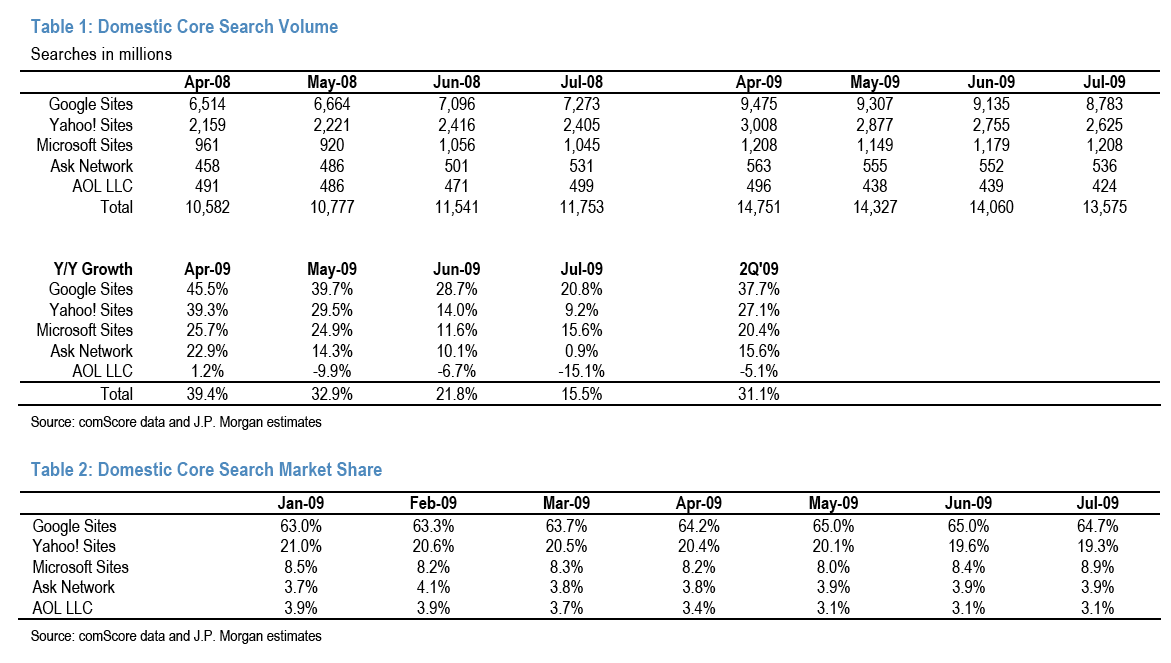
At 30 million queries a day, that comes out to about 900 million queries a month, which would make Yahoo BOSS the fourth largest search engine in the U.S. with about a 6 percent share. That is just below the 9 percent share (and 1.2 billion queries a month) comScore estimates for Bing.

But that is based on data from April. The chart is missing the last three months because Yahoo won’t update the numbers (I asked). Depending on the growth rate of Yahoo BOSS search queries since then, BOSS should now either be at par with Bing or even slightly larger. Between February, 2009 and April, 2009, search queries grew 50 percent (from 20 million a day to 30 million). Here are three different growth scenarios for the period May through July and the corresponding search volume numbers they would imply:

    Growth Scenarios
  1. 50 percent growth = 45 million queries a day = 1.35 billion queries a month
  2. 40 percent growth = 42 million queries a day = 1.26 billion queries a month
  3. 30 percent growth = 39 million queries a day = 1.17 billion queries a month

Remember, Bing was at an estimated 1.21 billion queries a month for the month of July. So BOSS might very well be as big as Bing. In fact, a couple months before the Bing-Yahoo deal, I kept hearing from people connected to Yahoo that BOSS on its own was bigger than Microsoft search. Now Microsoft owns BOSS as part of its deal to take over Yahoo’s search operations.

On the day the deal was announced, Microsoft SVP Yusuf Mehdi told me that he wants to keep BOSS alive because “there is a lot of goodness there.” I’ll say. It adds about another six points to Bing’s overall search volume market share. (Click the market share table below to enlarge).

july-search-volume-tbale

twitter company profile

Twitter

Twitter, founded by Jack Dorsey, Biz Stone, and Evan Williams in March 2006 (launched publicly in July 2006), is a social networking and micro-blogging service that allows users to post their latest updates. An update is limited by 140 characters and can be posted through three methods: web form, text message, or instant message. The company has been busy adding features to the product like Gmail import and search. They recently launched a new site section called “Explore” for external and third party tools that interact with Twitter and a new visualization tool called Twitter Blocks.

The service was started by Obvious Corp, who also started Odeo.

In April 2008 Twitter launched Twitter Japan in partnership with Digital Garage.

Milestones

  • 6/23/08 — Hires Rudy Winnacker and John Adams, two new Operation Engineers 6
  • 6/9/08 — Survives iPhone 3G Stevenote 7
  • 6/9/08 — Twitter partners with Summize to cover Apple news. 8
  • 5/28/08 — Launches a status blog to communicate to users better about issues with the service. 9
  • 5/7/08 — Twitter Starts Blacklisting Spammers 10
  • 4/24/08 — VP Lee Mighdoll Leaves Twitter 11
  • 4/23/08 — Chief Architect Blaine Cook Leaves Twitter 12
  • 4/22/08 — Twitter Japan Launches 13
  • 4/16/08 — Twitter helps bust American man out of Egyptian jail 14
  • 7/15/06 — Twitter Launches 15
  • 3/21/06 — First Twitter 16

General Information

Websitetwitter.com
Blogtwitter.com/blog
Twitter@twitter
CategoryConsumer Web
Emailpr@twitter.com
Employees29
Founded3/06
DescriptionSocial networking and microblogging

Offices

San Francisco, USA
539 Bryant Street
San Francisco, CA, 94107
USA

People

Product Development
Co-founder & Creative Director
Distributed Systems Architect
Engineer
Operations Manager
Senior Operations Engineer
Operations Manager
Operations Engineer
Lead of User Experience Team
Engineer
Board Member
Engineer
Director of Engineering and Ops
Co-Founder, Chairman
Advisor/Investor
Engineer, User Experience Group
Co-Founder, CEO
General Counsel
Chief Scientist
board of directors
Director of Search

Acquisitions

Values of n, 11/08 1
Summize, 7/08 2

Funding

Competitors

Digg, Pownce, ZYB, Jaiku, Zannel, mocospace, Chatterous, trymehere, Twitturly, TwitterFone, LetsProve, Plurk, Adocu.com, InGameNow, Posterous, Next2Friends, Hictu, kwippy.com, spotengine, Present.ly, Me2day, Xumii, Collecta

Screenshots

Twitter screenshot
Above: Twitter Home Page July 2009
Uploaded: 7/25/09
Twitter screenshot
Above: Twitter Homepage as of July 28, 2009
Uploaded: 7/29/09
Twitter screenshot
Above: Twitter search results page as of July 28, 2009
Uploaded: 7/29/09


courtesy: crunchbase